
Applying Project Management Principles to a Complex Family Liquidation
The Situation
My family needed to liquidate the contents of an estate without the expense of hiring a professional estate sale company. The estate contained the belongings of four family members across two generations, accumulated over many years in a rural small-town property.
The challenge wasn’t simply to “hold an estate sale.” We needed to determine the right audiences for different items, generate traffic in a small market, and remove as much inventory as possible. Every item that didn’t find a home represented a potential disposal expense.
I approached the challenge as a project management problem rather than an informal family undertaking.
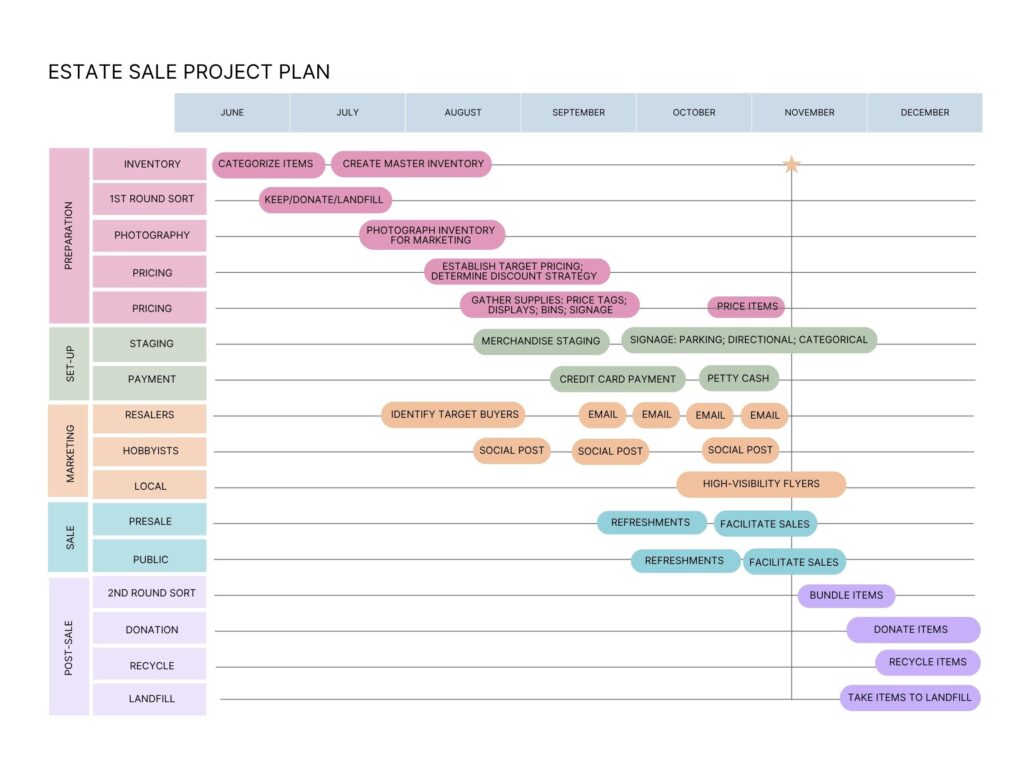
With a four-person “project team” consisting of myself, my spouse, my sibling, and my sibling-in-law, I developed a structured plan spanning inventory and sorting, pricing, marketing, presales, physical setup, public sales, donation, resale, disposal, and financial closeout.
The Solution
I built a predictive, waterfall-style project plan that broke the estate liquidation into defined phases, deliverables, dependencies, and workstreams.
The first phase was inventory and disposition planning. We sorted the estate’s contents into categories including items to retain, items to sell, items appropriate for professional resellers, items to donate, and items that would ultimately require disposal. This gave us a clearer picture of the inventory and allowed us to develop different strategies for different audiences.
From there, I developed parallel sales and marketing workstreams.
Targeted Outreach
Rather than relying exclusively on traditional estate-sale traffic, I identified professional resellers and specialty buyers who might be interested in purchasing inventory in larger quantities.
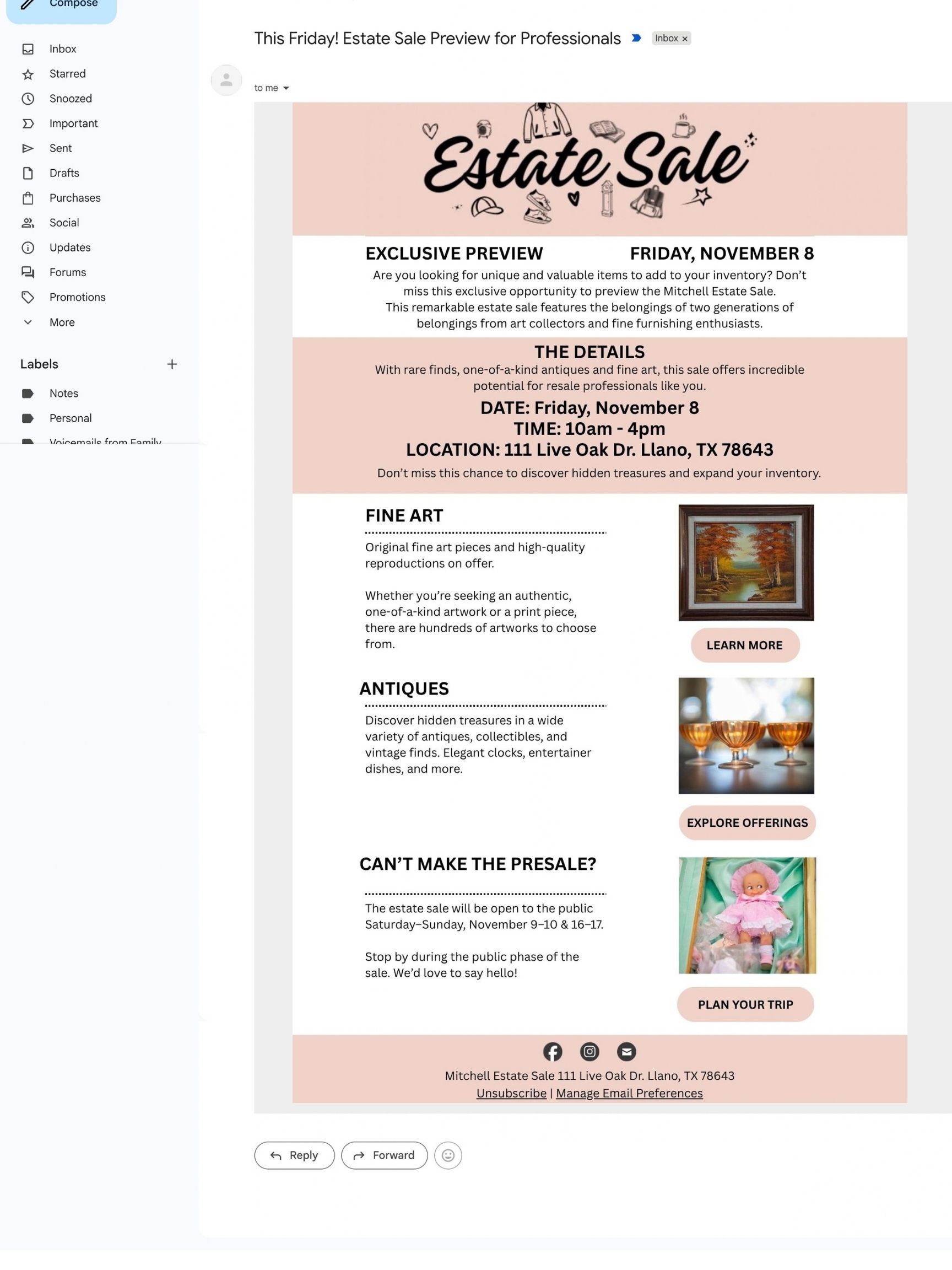
I developed a series of targeted communications and facilitated opportunities for resellers to purchase items before and during the public sale.
Public Marketing
For the general public, I developed a multi-channel marketing strategy designed to overcome the limitations of a rural location.
- Created social media content promoting the sale and featured inventory
- Designed physical flyers and signage for high-traffic locations
- Built a WordPress website dedicated to the sale
- Listed the sale on leading estate-sale listing platforms
- Developed messaging tailored to different buyer audiences
- Used HubSpot to track marketing activity and performance across channels
This approach allowed us to treat the sale like a small marketing campaign rather than simply posting an announcement and hoping people would show up.
Operational Execution
Behind the marketing effort was a detailed operational plan covering staging, pricing, payment methods, customer flow, inventory management, sales, pickup, and post-sale disposition.
The team staged merchandise by category and audience, established processes for transactions and sold-item removal, and maintained a clear sequence for moving remaining inventory from sale → reseller → donation → disposal.
The project approach also helped us make decisions before we were under pressure. Rather than treating every unsold item as a last-minute problem, we had already established downstream disposition channels.

The Success
The estate sale generated $7,000 in cash proceeds after all expenses were paid, but the financial result was only one measure of success.
The project also achieved its larger operational objective: the vast majority of the estate’s contents found a new home rather than going to the landfill. Items were sold or gifted to professional resellers who could repurpose them, while a substantial amount of remaining inventory was donated. Only a small amount ultimately required landfill disposal.
The project demonstrated that the same disciplines I use in professional marketing and operations—scoping, work breakdown structures, audience segmentation, cross-channel marketing, resource planning, performance tracking, dependencies, and closeout planning—can turn an overwhelming, ambiguous challenge into an executable project.